Showing posts with label Wildflowers. Show all posts

Tuesday, 26 April 2016

Broadway Tower and The Cotswolds Ecology

I love living in Worcestershire. One of the many reasons is the proximity to the Cotswolds Area of Outstanding Natural Beauty. On a spring day when the sun shines there is nothing better than to go for a walk in the Cotswold Hills and admire the beauty of the natural world. The soft rolling hills, the orange stone and the idyllic English villages. What more could you ask for?
High Street, Broadway

Walking up the Broadway Tower 
The Cotswolds are an area of hills that rise up from the Severn valley and are made of an outcrop of oolitic limestone. It is this Jurassic limestone that gives the villages their characteristic appearance and it also gives the hills a unique ecology. This means there is often something interesting to see from a wildlife point of view. Our recent walk up Broadway tower was no exception. The tower itself sits at the top a the limestone escarpment (313m above sea level) above the picturesque Worcestershire village with houses built from the Cotswold stone. The walk is pleasant and it gave us plenty of opportunity to enjoy views across the Severn valley and of the village of Broadway. 

Broadway and the Seven valley

Enjoying the View

It is the rock that gives the area their appearance and their ecology. It was formed in the Jurassic period 150-200 million years ago in warm shallow seas. Like all limestone they are made predominately of calcium carbonate. This will have formed from the shells of dead sea creatures that were deposited on the sea floor. It can be fun to put this to the test. Pour a few drops of vinegar onto the rock and if calcium carbonate is present it will fizz. The acid is reacting with the carbonate to produce carbon dioxide.

Red-tailed bumble bee Queen
Common Field-speedwell. Small blue flowers with triangular leaves

From an ecological perspective the area is primarily made of rare limestone grass land broken up by arable fields and beech woodland. In fact the Cotswolds hold 50% of the UK's unimproved limestone grassland. It is therefore a haven for a range of plants and insects that are not found anywhere else. Unfortunately we were a little early in the year to spot the Chalkhill Blue and the Duke of Burgundy butterflies!

Dandelion and hoverfly

Forget-me-knot. Seen everywhere in the Cotswolds 
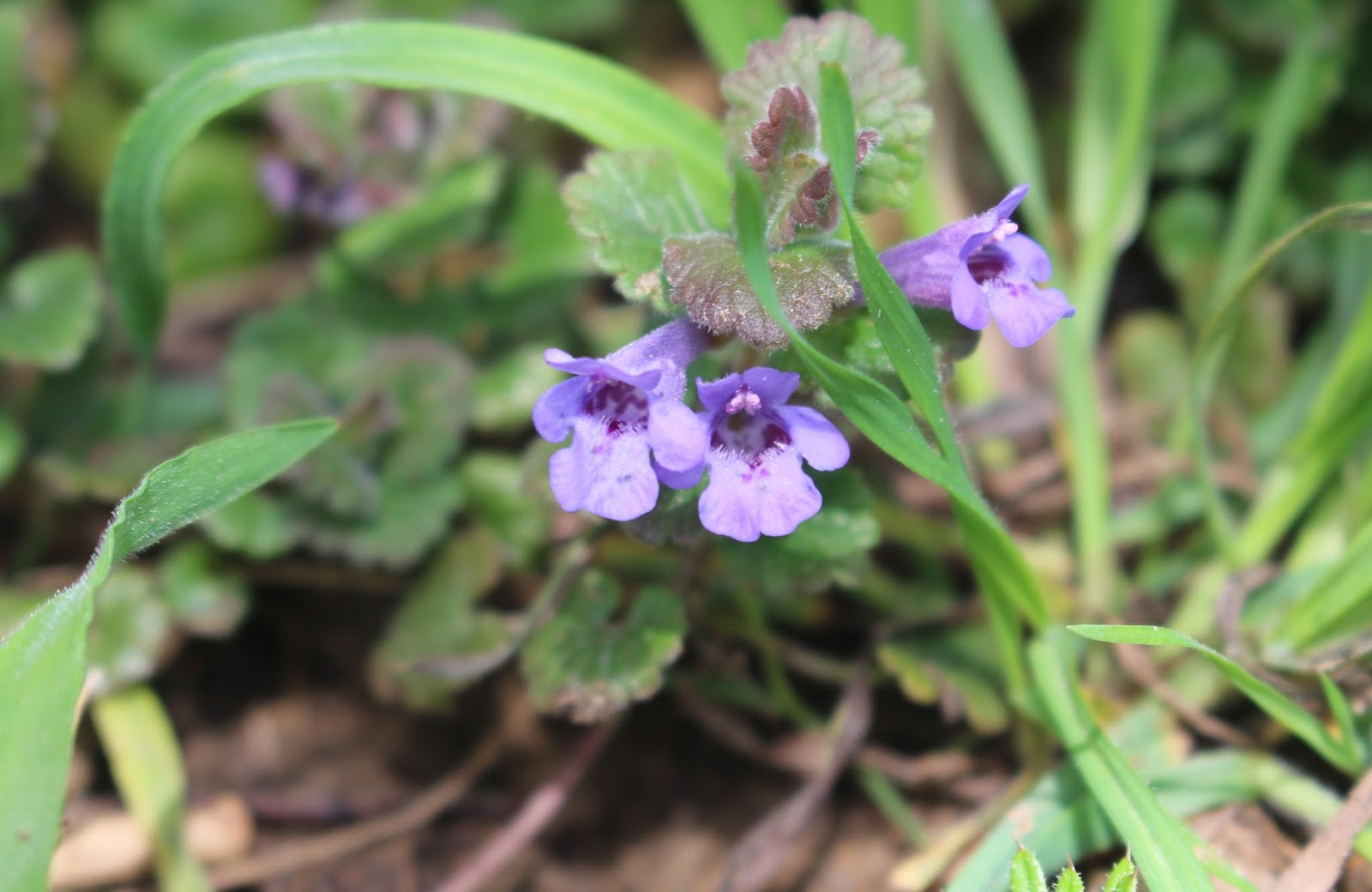
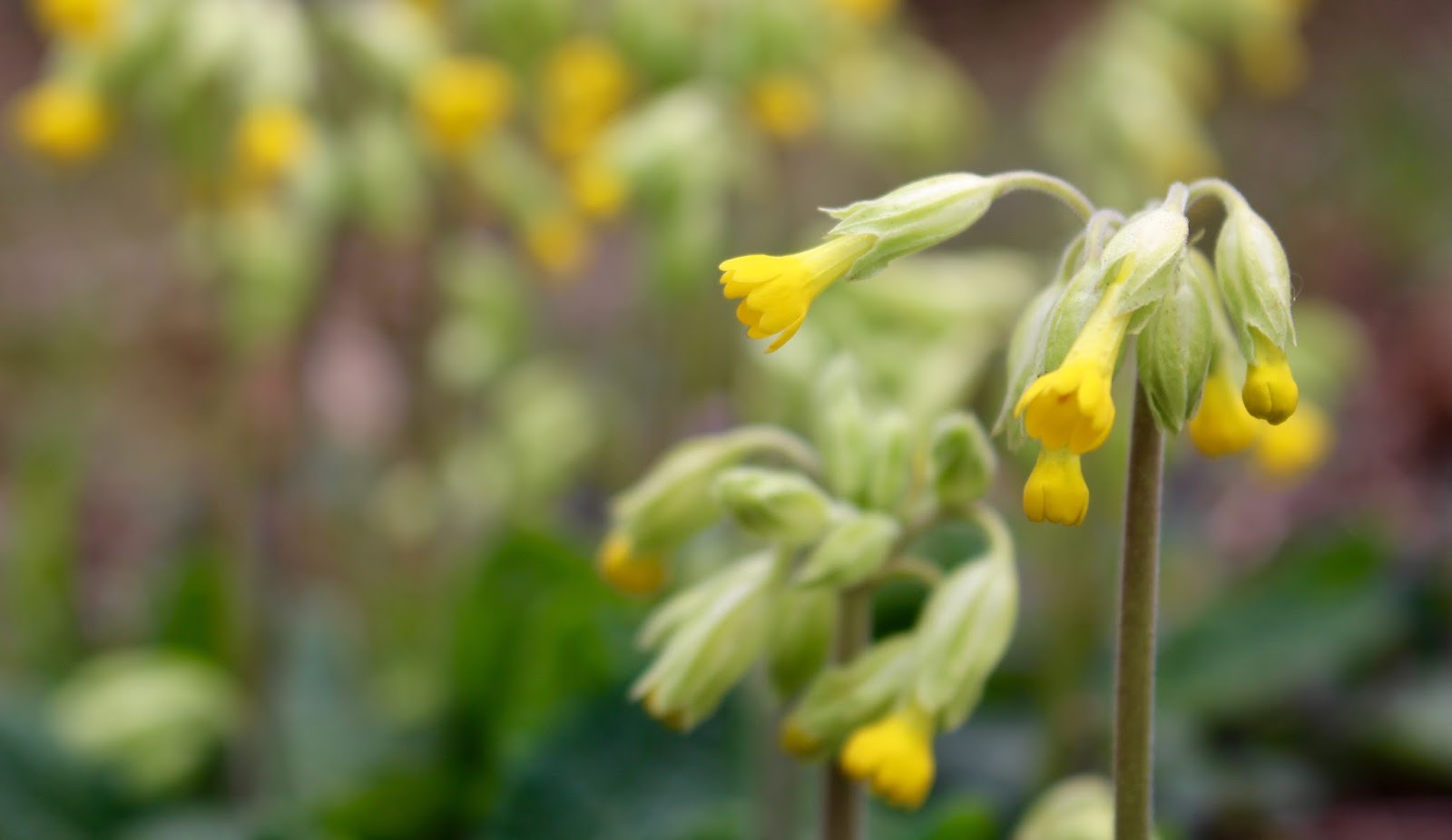
However, there was still plenty to see. The flowers that predominated on our Broadway tower were Forget-me-not's, Ground Ivy, Cowslips and in the woodland there were Dog-violets and lots of Bluebells. All of these are species that can be found on any bare patch of ground or road verge. It was nice to see them and the range of pollinators that they rely on to produce seeds for the next generation.

Ground Ivy: Creeping plant with Small Blue 

Dog Violet: Small blue flower with heart shaped leaves

There were plenty of bees and hover flies. In fact I spotted one of my favourite flies the Bee Fly. They are identified by being a fly (short antenna and one pair of wings) that looks like a bee and having an impressively long probosces. They feed on nectar and pollen, it is that long probosces that they have evolved that gives them the advantage. It enables them to reach the nectar in flowers that have long and narrow floral tubes, such as cowslips and bluebells. The larvae stage is a little more sinister. The adults will lay their eggs in the nests of solitary bees, such as the mining bee, the it will consume the bee larvae before hatching out into the stunning bee fly adult. Therefor the bee flies need to live in an area rich in flowers like cowslips and where mining bees live.

Bee Fly. Notice the long ridged probosces

Cowslips. Perfectly evolved for Bee Flies
It is great to see this range of plants and animals. I sometimes feel that in Britain the countryside is very sterile. This is as a result of the intensive farming that takes place across most of it. Indeed the cotswolds are not exempt from that. There is a lot of sheep grazing and that has a detrimental affect on the range of wild flowers present. This then has a knock on effect up the food chain. Sheep do have a negative effect on biodiversity as they eat a much wider range of plants than other grazing animals.

Broadway tower and the heavily grazed grassland
The Cotswolds. Sheep eat everything!

The key word is biodiversity: the more species of flower the more variety of insects there will be to pollinate them. An increase in the numbers of invertebrates will give rise increases in birds and small mammals. We all benefit from the existence of pollinators as without them the majority of our crops can not produce fruits and seeds. It is also fascinating to learn and understand the complex and interwoven lives that all these animals and plants live. No species lives in isolation and the interactions between cowslips, mining bees and bee fly highlight that. 
Bluebell 

Cuckoo Flower
Hawthorn

Tuesday, 15 March 2016

The Excitement of a Red Kite and Wildflowers

I love Winter, the cold frosty mornings, the dark nights, the crisp fresh air. But, however much I enjoy winter I am always glad to get that first glimpse of spring. That first warm day when you feel and sense that life is ready to spring into action for another year. This last weekend I really had that feeling and it felt good.

Lesser Celandine

Still a Lot of Water About

On Saturday we went for a walk around the landscape park at Croome. Such a beautiful part of Worcestershire and there can be a surprisingly large amount of wildlife about. Our walk produced 38 species of bird, the highlight was great views of a female Sparrowhawk. We also enjoyed watching the resident little owl and a fly over from the ever increasing Red Kites.
Red Kite and Buzzard

The Excitement of watching a Female Sparrowhawk

The story of the Red Kite is a real positive one for conservation. They were once seen as vermin and exterminated across England, only a small population survived in Wales. In 1989 they started introducing Kites to the Chilterns. Now there are possibly 1000 breeding pairs. Over recent years the numbers of sightings in Worcestershire have also increased. It was exciting to see my first of the year. Hoping for many more sightings.

Ground Ivy
An early Bluebell 

The Woodland Undergrowth Coming Through
What was particularity exciting to see at Croome at the weekend was the emerging undergrowth. There was the smattering of green leaves from the wild garlic and nettles breaking through the detritus on the woodland floor. Around the greenery there was the sightings of some wildflowers. It is great seeing the bright and colourful petals this time of year, really give a sense of hope. It was amazing what we found. Inevitably we came across lots of Lesser Celandine, primrose, snow drops but also we came across some ground ivy and a very early bluebell.

Nettles 
An area left for rewilding

On Sunday we had a walk around the canal, river and local nature reserve. Again it was exciting to see the numbers of wild flowers about. However, the area that really stood out was a small patch of ground next to the canal. It is an area that has been left bare after building works. No grass planted and hardly any topsoil, just left to take care of its self. It does get regular mowing, so after approximately two year since the area was “created” grass has begun to dominate. However, it was fun to stop and look at the wildflowers that had taken seed there.

Colt's-foot 
Common Field-speedwell
Red Dead-nettle

The way that nature will reclaim land and transform baron areas into beautiful green havens for wildlife is amazing. This process of succession is great to witness. We paused on our walk to take in the area. We saw plants like Colt's-foot, Forget-me-not, Red Dead-nettle and dandelion these are plants that are often found on waste ground and beside footpaths. It is always worth stopping and taking a look as you never know what you might find. Often people think of them as weeds but I think that they offer a little extra interest than the manicured, uniform, monoculture of grass.

Field Forget-me-not