Monday, 13 July 2015

Important Citizen Science

When we planned our weekend activities we realised that our initial idea of a big walk was not going to be possible. Instead we took inspiration from a youtube clip that we saw on the BBC Earth Facebook page by Sir David Attenborough. He spoke of the importance of citizen science and individuals going out and helping larger organisations collect data on wildlife. https://www.facebook.com/bbcearth/videos/1017274611639428/
We sat down and decided that we wanted to carry out not one but two different surveys on Saturday. My Daughter was very excited about them both and also about carrying out some very important ecological research.

The Big Butterfly Count
Cherry Orchard Nature Reserve - Worcester

The first survey was the Big Butterfly Count, which Sir David Attenborough also has been encouraging people to take part in. http://www.bigbutterflycount.org The other was the Bee Scene survey for Plantlife. http://www.wildaboutplants.org.uk/beescene/ To do both of these surveys we chose the local nature reserve in the centre of Worcester just a few hundred metres from our house. Saturday was a beautiful warm sunny afternoon, perfect for looking for wild flowers, bees and butterflies.

Bee Scene Survey

Ringlet

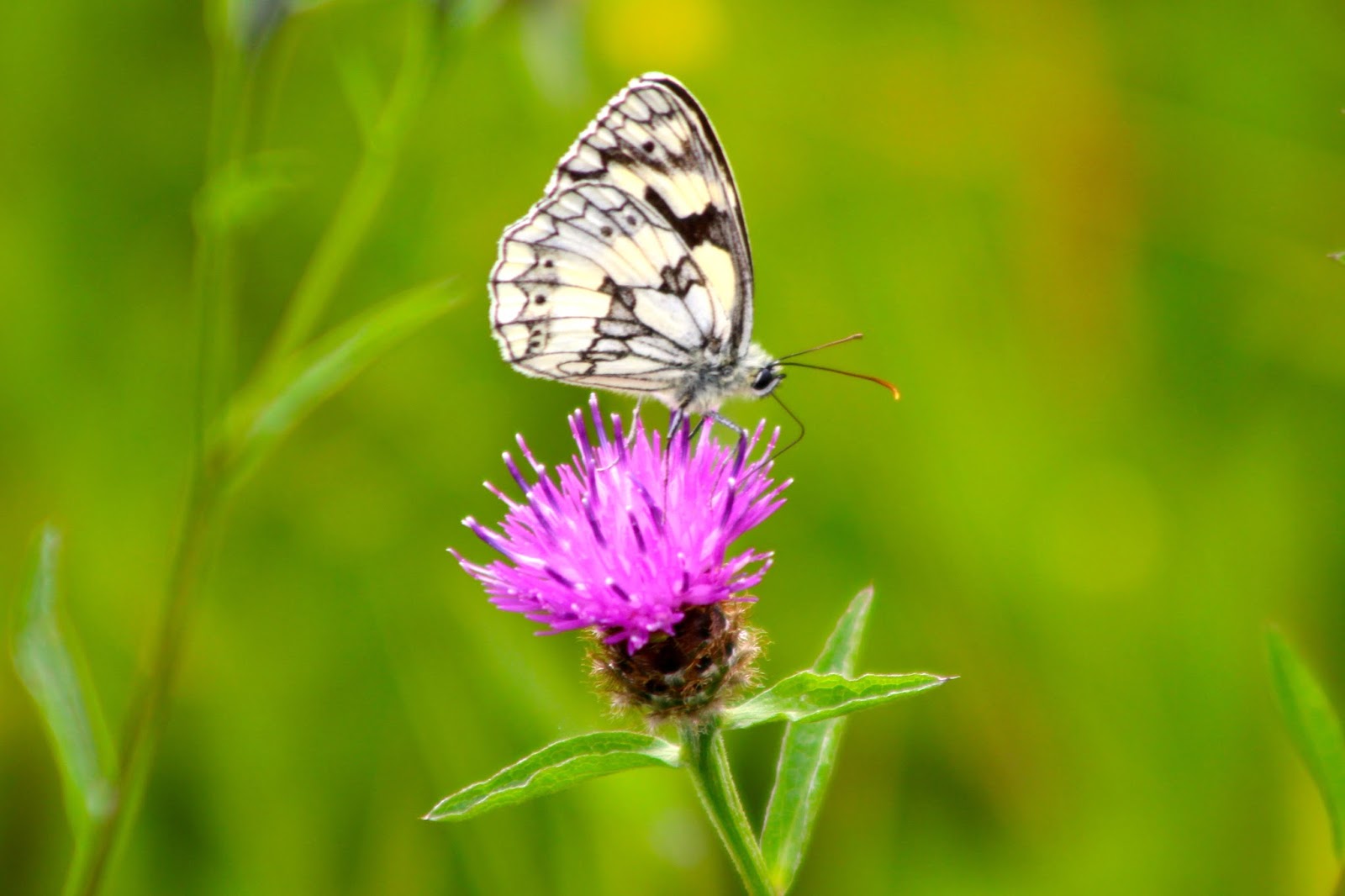
Cherry Orchard Nature Reserve is a real natural treasure and on Saturday it did not disappoint. As far as butterflies were concerned we spent our fifteen minutes sat in one of the open areas of unimproved grassland and counted a total of 8 species. There were lots of Large Skippers, Ringlets and Meadow Browns. The highlight for us was the Marbled White. It is such a stunning butterfly to see with the contrast between the white and black on its wings. It enjoys the nectar of clover, knapweed and thistles. Due to the high concentration of these plants I was not surprised to see a couple of the Marbled Whites.

Large Skipper

Large White

Marble Whites are like the vast majority of British butterfly's and are in decline. Reading reports and looking at statistics is very depressing. 60% of our butterflies are in decline and one in ten faces extinction in Britain completely. Yet here we were in a small nature reserve in the centre of Worcester surrounded by plenty of them. The key thing is habitat, the unimproved grassland of the nature reserve provides the variety and types of flowers they need to support them. Unfortunately, this is not the case in a lot of areas of our country. We are cutting grass verges instead of letting them flower, making more silage and less hay, we are selecting plans for the garden based solely on what they look like instead of what they can provide wildlife. As we change our agricultural practices and gardening habits we are not providing what the butterflies need.

Marbled White

Gatekeeper

The Bee Scene survey by PlantLife, which was aimed at getting children involved in wildlife, was a lot of fun. We had to survey the area to decide if it was “not good”, “good” or “very good” for Bees and flowers. We had to look at the types and colours of the different flowers and then see how many types of bees we could find. On Saturday there were 5 different species of bumble bee. And a very large number of wild flower. Our overall conclusion was that this area was very good.

Red-tailed Bumble Bee

Common Carder Bee

Indeed, we need to take a big lesson from areas like this. Here in the centre of Worcester there is a small nature reserve that is providing a wealth of habitats that support our species. It is providing an opportunity to reverse the decline in numbers of insects and other wildlife that we have seen in the last 50 years or so. We need more areas like this across out towns and cities and in the wider countryside we need to provide areas that are supportive to wildlife.

Unimproved Grassland

Agrimony

Another important thing that these areas do is they provide an opportunity for us to take note and engage with the wildlife. You can stroll around the area and see an abundance of all kinds of wildlife from bugs to flowers to birds and mammals. My daughter really enjoyed doing her little bit for science and having some interesting encounters with the bees and butterflies. It is only when we take our children out and let them enjoy these areas and take notice of nature will they learn to understand it and to love it. Then they will want to protect it in the future.


A Grasshopper Getting in on the Action


Large Skipper

Large Skipper on Red Clover


Common Vetch


Tuesday, 7 July 2015

Summer Evening's in the Garden

Due to a variety of reasons wildlife and the outdoors did not play a major roll in the weekend. However, that did not stop me from having a few interesting encounters at various stages. So, I took hold of what little time I had, which, resulted in the major part of the wildlife spotting taking place in the garden. The first opportunity was on Friday evening when we enjoyed a champagne cocktail sat outside on a warm evening. From a wildlife perspective this meant listening and watching the swifts. There was a total of 33 counted at one point in the evening. In addition to the swifts we spotted Collared Doves, House Sparrows, Mistle Thrushes, Blackbirds and of course the Lesser Black-backed Gulls.

Champino Cocktail in the Garden

Lesser Black-backed Gull

Worcester is fortunately home to around 250 breeding pairs of this gull of conservation concern. 40% of all Lesser Black-backed Gulls live in the UK and their numbers are in decline. However, their numbers are increasing in our cities and Worcester is one of them, this has really boosted their numbers. I find them fascinating birds and I was initially pleased when one decided to nest on the roof opposite us.


Lesser Black-backed Mother and Chick

Lesser Black-backed Gull Chick

However, not all Worcester residents are as happy about them as me. They can cause problems in the city. They make mess both by ripping apart bins and spreading rubbish around the High Street and the obvious bird poo situation. The other problems are the noise and the fear factor as they swoop low over peoples heads. There have even been some reports that they have taken food from peoples hands. In resent days it has been the noise issue that I can sympathise with as approximately 4 o'clock every morning we are woken up by the continual squawking. On balance, however, I would want them to stay.

Black tailed skimmer

Marbled White
I did get a short walk around Grimley on Saturday afternoon. It was a hot but pleasant afternoon. It was great watching the large numbers of Black-tailed Skimmers and the damselflies that darted across the causeways. The thing that stood out was something quite plane and simple: Knapweed. It is a common and, I think, over looked plant but has stunning colours. It was also proving to be an excellent pollinator. The most common visitor was the Meadow Brown butterfly but quite a few other insects were enjoying their lunch at the Knapweed table. Sometimes I just enjoy sitting back and marvelling at some of the more common species. It is not always about the rare and endangered species.

Knapweed and Meadow Brown


Common Blue and Red-eyed Damselfly

The weekend ended up back in my Garden on Sunday afternoon and I took a few photos of the insect life that I could spot. Rather disappointedly I discovered the larva of the Gooseberry sawfly doing it best with the Gooseberry bush. It was also nice to see two species of bee and a small collection of hover flies. The real disappointing species was the Green Bottle Fly. It was there for one reason only: to lay its eggs in the cat faeces. Yes unfortunately the neighbourhood cats use our garden as their toilet.

Gooseberry Sawfly

I think it is sometimes easy to overlook the wildlife potential that can be found in our gardens. Especially when our gardens are very small like mine. However, they can occasionally produce something interesting and intriguing, just have to keep looking. 

A Hoverfly

A hoverfly

Tuesday, 16 June 2015

Adventures in Monkwood

Monkwood was the destination of our wildlife adventures this weekend and it did not disappoint. It is an area of semi-natural, ancient woodland just a few miles north of Worcester, near a village called Sinton Green. There has been woodland here from at least the year 961, impressive. The woodland is jointly owned by the Worcestershire Wildlife Trust and Butterfly Conservation and covers an area of 152 acres.

Looking for Birds

The Woodland Ride

Shortly after getting out of the car my 11 year old daughter asked to take the camera as she wanted to take photos of plants and invertebrates. I handed her the camera and she got involved exploring the woodland.

Solider Beetle

Another Beetle

Monkwood is a stunning place to visit and enjoy a few hours wandering around. The management of the woodland has created wonderful wide woodland rides which we had the pleasure to walk through. The sun was pushing through the clouds intermittently creating some beautiful light. It was such a pleasure meandering along the footpaths. My daughter, on her photographic adventure, commented about the Common Hogweed flowers. “Each flower head has loads of insects, and on each flower head the insects are all different.”

Buff-Tailed Bumble
Common Hogweed Flower Head with Invertebrates 

She was correct. To stop and acknowledge the biodiversity supported by something as common and familiar as Common Hogweed was quite mind blowing. The Hogweed is an impressive plant in its own right and could easily be overlooked. Growing large dominating leaves and sending up a tall flower stalk upwards of two meters in some cases. It makes it stand proud of the surrounding flora. The large white flower heads, comprised of hundreds of individual flowers, with delicate hints of pink and yellow, which act as a beacon for the passing pollinators. Consequently each flower head was teaming with flies, bees and beetles; some large and many small but all playing their part in increasing the interest and biodiversity of the woodland.
Hoverfly

Common Hogweed Flower Head

The best find of the day was the crab spiders (Thomisus spectabilis). Crab spiders are fascinating arachnids as they are not your typical web creating hunting spider. They exploit the evolution technique of camouflage and wait to ambush their victim using their long 'crab' like front leg to hold the pray when they provide it with a fatal bite. Perhaps the best bit of Biology is the way they are camouflaged, they can change the colour of their body to match the colour of the flower they are living on. In our case, on the Hogweed, the spiders were white. We even spotted one with a hover fly in its grip.

Crab Spider with Hover Fly

Longhorn Beetle and Others

Other notable species we found on or around the Hogweed were Solider Beetles, Yellow and Black Longhorn Beetles, Thick-legged Flower Beetles, Dock Bug, Green-legged Sawfly. However, we really went there to spot some butterflies. Unfortunately only 2 species were noted.

Yellow and Black Longhorn Beetles

Green-legged Sawfly

We did spot a Large Skipper and a Speckled Wood. The Large skipper was enjoying the nectar of the plant Ragged Robin. Ragged Robin is a plant that is wide spread across Britain and tends to be found in wet meadows and wet woodlands, such as Monkwood. Due to the reduction in meadows it has unfortunately seen a decline in its numbers. It is important nectar source for many species, such as this Large Skipper, and many other butterflies and long tongued bees.

Large Skipper on Ragged Robin

Look at that tongue

All in all we had an exciting few hours but most importantly my daughter really engaged in the wildlife and had fun. I feel it is so important to allow children to engage in nature, it helps then love and understand wildlife and see why it is important to our planet to have healthy ecosystems. Then they will want to protect them in the future. All photos were taken by her, (except the very first one).  

Large Skipper

Dock Bug

Fly


Wednesday, 10 June 2015

Sunny Days Volunteering to Help Nature

On Sunday we as a family got involved with some volunteering at the local nature reserve. I love volunteering, there is something intrinsically rewarding about giving up your time for someone else or something else. I especially enjoy volunteering in conservation, as it is my opportunity to give back all the enjoyment that I take from our natural environments, ensuring that they remain as they are. On this occasion we were part of a small team tasked to remove as much of the invasive and non-native Himalayan Balsam as possible. We started at the Diglas Bridge and worked our way south. 


Removing Himalayan Balsam
  

Himalayan Balsam

 Himalayan balsam is a tall, fast growing annual plant. This means that it grows from seeds each year. It also spreads very quickly as it has a very effective seed dispersal method. An individual plant can spread its seeds up to 4 meters away. Additionally, due to favouring riverbanks it can spread its seeds down stream. This has resulted in vast areas of the Severn becoming over run by the balsam.


Ephemera vulgata - Drake Mackerel Mayfly  

Red-tailed Bumblebee

It alters the ecology of ecosystems in a number of ways. Firstly, it is an annual, so when it has finished its seed dispersal it dies down completely. This means that there is no root material to hold the river banks together. This can have severe effects when rivers flood in winter. So there is an increase in soil erosion.


White-tailed Bumblebee

Gall from Willow Redgall Sawfly

Due to its fast growing nature, and height (2.5m), it will out compete native plants. It grows in large dense thickets that suppress our native species. It also out competes our native plants in the pollination department. It produces large quantities of pollen over a long season. This then results in many pollinators avoiding our native species in favour of this invader. Our native species lose out in several ways and it all has the same effect – it reduces our biodiversity by up to two thirds. We need to get rid of it!

Tree Bumblebee

When we were at the nature reserve I was impressed with the quantity of comfrey. There were good quantities of it between the balsam. It was doing an amazing job of providing pollen for the bees. I stopped pulling up the balsam to enjoy the insect life that the Comfrey was supporting. There were several species of bee, grasshoppers, mayflies, damselflies. It was amazing to see. It was also hard not to be inspired by the continual sound track provided in the back ground by the birds: Blackbirds, Song Thrushes, Wrens, Blackcaps and both species of Whitethroats.

Whitethorat


Common Spotted Orchid

After the volunteering there was a big community picnic to bring together the people of the area. This was a lot of fun, bringing the wider community together, and with the hot sunny weather it was a special day. After that I had the pleasure of walking around the Nature Reserve with some of my good friends and their 3 year old son. It was the first time they had seen the reserve and it was a real privilege watching there son engage with the natural world in a positive way. It was clear that he enjoyed his time walking around the Nature Reserve, it was great to see his reaction to spotting a Green Woodpecker. These small reserves in city centres are an important part of our wider approach to help prevent the decline in so many of our species. They also provide an opportunity for us to be able to destress, relax and enjoy the beauty of our natural world, possibly the best medicine in the world. 
Common Blue Butterfly